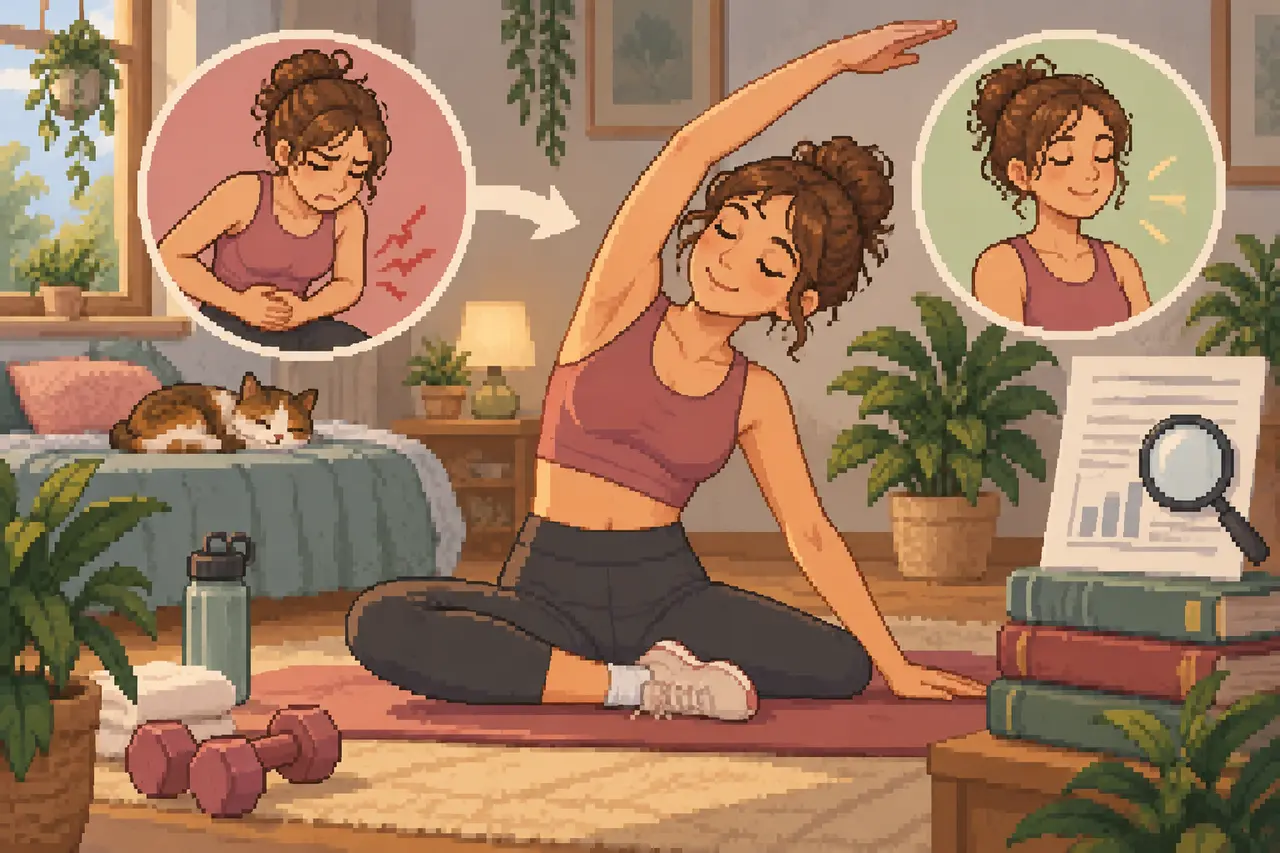
In brief
- A meta-analysis of 29 trials demonstrates measurable reductions in menstrual pain intensity from exercise interventions.
- Mind-body routines primarily reduce overall symptom severity, whereas aerobic and strength exercises target pain intensity.
- The certainty of the scientific evidence was formally evaluated as low to very low according to the GRADE criteria.
- Physical activity is not an individual cure and should never replace professional medical care for persistent symptoms.
Exercise for Primary Menstrual Pain: Evidence and Reliability
Cramps can disrupt everything. You might be resting on the couch with a warm heating pad, struggling with familiar abdominal pain while wondering whether even a brief walk could bring meaningful relief. Movement feels daunting. When you search online for exercise menstrual pain studies, you quickly encounter sweeping promises about miraculous workouts that claim to banish cramps forever. We examine the published clinical data calmly, explaining what research proves and where scientific uncertainty remains.
Clinical medicine separates menstrual discomfort into primary and secondary categories. Primary dysmenorrhea involves painful cramping without any detectable pelvic disease, whereas secondary pain arises directly from identifiable structural conditions such as endometriosis, uterine fibroids, adenomyosis, or chronic reproductive infections. Prostaglandins drive these cramps. These natural lipid compounds cause intense contractions of the uterine muscle, temporarily restricting local blood flow and sending prominent pain signals throughout the lower abdomen. Secondary symptoms always require clinical care. Never force yourself through strenuous training when your body asks for gentleness and rest.
What exercise menstrual pain studies reveal so far
A 2026 meta-analysis provides answers. Researchers analyzed 29 randomized controlled trials that enrolled 1704 women with primary dysmenorrhea, testing structured physical activity programs against standard control conditions across multiple medical centers worldwide. The tested regimens spanned gentle yoga, stretching routines, and vigorous aerobic workouts. Investigators tracked pain intensity. They also measured overall symptom severity and calculated whether regular movement noticeably shortened the duration of acute menstrual cramping episodes during subsequent bleeding cycles.1
The investigators systematically searched 8 major international medical databases through January 31, 2026, including PubMed, Embase, Scopus, CENTRAL, Web of Science, ProQuest, PEDro, and CINAHL. Broader outcomes were evaluated. Authors tracked psychological anxiety, everyday quality of life, and subjective sleep quality. To gauge study validity rigorously, the researchers appraised methodological bias across all 29 trials using the standard Cochrane Risk of Bias 2 instrument. This creates a solid baseline.1
Pain intensity and associated symptoms in the data
The findings indicate clear benefits. Pain intensity dropped markedly, showing a large standardized mean difference of minus 2.17 among women assigned to regular exercise compared with inactive controls. Overall symptom severity also declined by minus 0.91 points. Pain episodes became shorter. The authors concluded that targeted muscular engagement, rhythmic movement, and deep breathing trigger favorable neuromuscular and circulatory responses throughout the pelvic floor.1
Quality of life and sleep scores improved alongside pain relief. Exercise types acted differently. Mind-body routines like yoga and stretching proved especially effective at diminishing general symptom burden, whereas aerobic training and resistance exercise exerted their strongest influence on lowering sharp pain intensity. Distinct biological pathways explain this divergence. Cardiovascular fitness enhances systemic circulation and tissue oxygenation, while mindful movement calms autonomic nervous system arousal to ease visceral muscle tension.1
How lasting are the measured benefits across menstrual cycles?
Persistence matters in daily life. Encouragingly, the meta-analysis found that therapeutic gains endured into the second menstrual cycle after participants completed their structured workout regimens. Relief did not disappear immediately. Sustained tissue perfusion, optimized hormonal balance, and reduced baseline inflammation likely account for these enduring post-intervention benefits across subsequent cycles. Habits beat sporadic bursts.
Group averages never guarantee individual success. When reviewing exercise menstrual pain studies, you must remember that mathematical means conceal wide variation in how different women experience identical physical workouts. Every person responds uniquely. A stretching routine that brings profound comfort to one person might prove totally ineffective or uncomfortable for someone dealing with distinct physiological sensitivities. Studies highlight possibilities, not personal duties. Your bodily comfort remains the primary compass on challenging cycle days.1
Limits of the research: What the studies do not show
Critical caution remains essential. Statistical heterogeneity across all measured outcomes was remarkably high, indicating that the 29 included clinical trials produced widely divergent results and used inconsistent intervention protocols. Evidence certainty is currently low. Under the standardized GRADE evaluation framework, reviewers formally categorized the certainty of the overall scientific evidence as low to very low. Many trials exhibited noticeable methodological limitations.1
Population boundaries are strictly defined. These published conclusions apply exclusively to primary dysmenorrhea, meaning that individuals with secondary pain from endometriosis, adenomyosis, or uterine fibroids cannot assume similar relief. Sport cannot cure disease. Movement will never replace a comprehensive diagnostic evaluation by a certified gynecologist whenever cramps feel unusually intense, persistent, or functionally debilitating. Professional medical care remains irreplaceable.1
What you can take away
The research provides encouragement. While clinical data show that physical activity can soften menstrual cramps, the modest quality of current studies urges a gentle, pressure-free mindset. Rest is always valid. Never feel guilty about choosing warmth and quiet over physical exertion whenever your body asks for stillness during painful bleeding days. Your intuition comes first.
Treat scientific evidence as flexible guidance. If gentle movement appeals to you, trying mild yoga stretches or an unhurried outdoor stroll represents an accessible, low-risk option to explore. Persistent pain demands medical evaluation. Partnering with a trusted healthcare professional ensures that any potential underlying gynecological pathology is promptly recognized and managed with appropriate therapeutic strategies. You remain in charge.1
- A meta-analysis of 29 trials confirmed statistically significant pain reduction.1
- Scientific evidence certainty was formally evaluated as low to very low under GRADE.1
- Mind-body routines decreased symptom severity, whereas aerobic training targeted pain.1
- Findings apply exclusively to primary dysmenorrhea.1
- Physical activity is voluntary and never replaces professional diagnostic care for severe pain.1
How this article was created
AI helps us with research and drafting. Before publication, a real responsible person reviews both language versions, every claim and the related sources.
This article provides general information and supports self-observation. It is not a substitute for medical advice, diagnosis or treatment.
Sources
- Effectiveness of Therapeutic Exercise in Reducing the Severity of Primary Dysmenorrhea and Associated Symptoms: A Systematic Review and Meta-AnalysisJournal of Clinical MedicineAccessed 21 October 2026
Reported limitations
- Heterogeneity across all analyzed outcomes was high.
- The overall certainty of the evidence was rated as low.