In brief
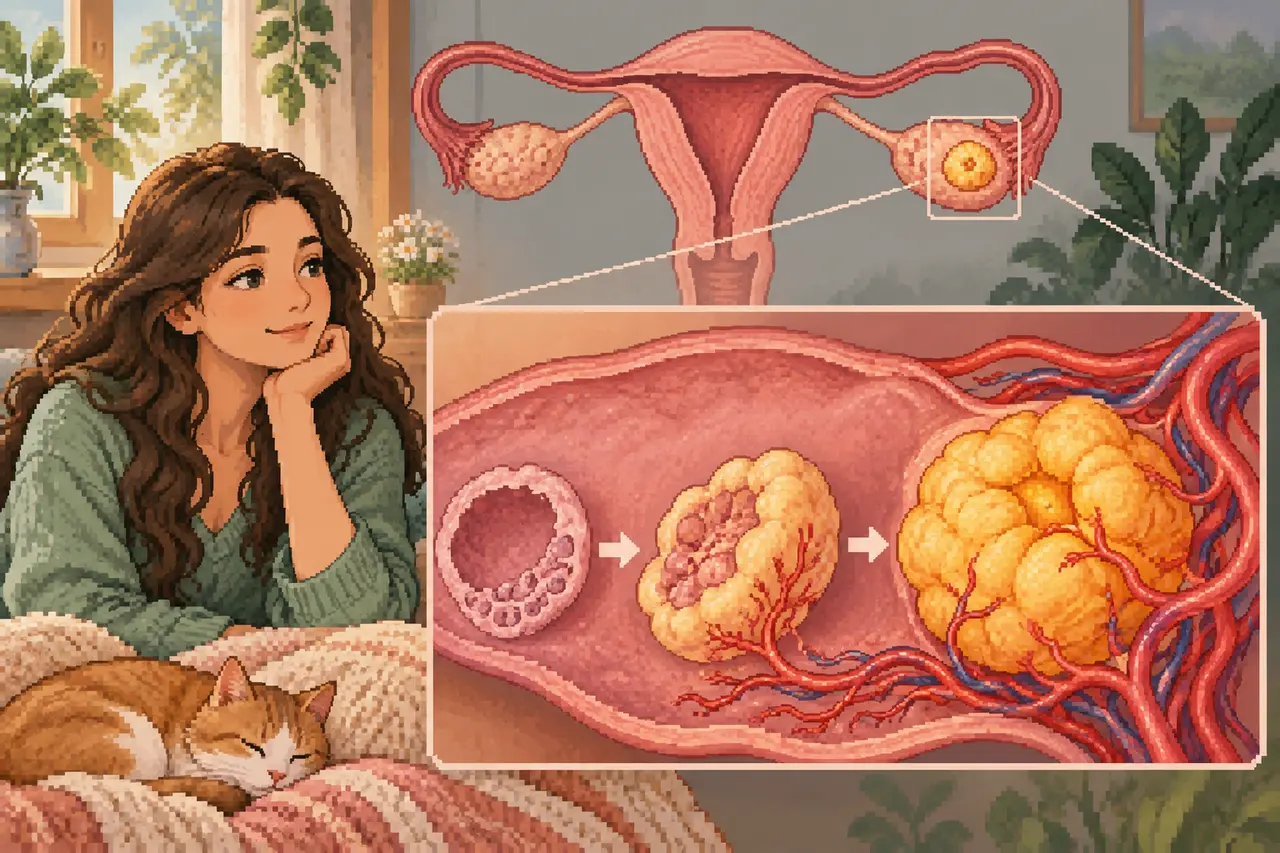
- Remaining granulosa and theca cells transform into a highly active hormonal tissue in record time following ovulation.
- An exceptionally dense vascular network supplies the gland with nutrients necessary for the intensive biosynthesis of progesterone.
- Cellular energy sensors align hormone production with resource status while resting energy expenditure increases across the body.
- Scientific evidence supports an attentive, nutrient-dense nutrition strategy free from dogmatic restrictions during the luteal phase.
How the Corpus Luteum Forms and What It Does
Craving carbs hits suddenly. You sit at your desk in the afternoon and notice an intense urge for sweet or starchy snacks. Your body feels warmer. Perhaps you also notice fatigue setting in much faster than before ovulation. Amazing biology is happening. Deep within your ovary, your system is performing a remarkable feat of rapid cellular remodeling from the remnants of the burst follicle. A temporary gland emerges. This corpus luteum takes charge of your cycle and demands measurable fuel, while we examine why your whole metabolism suddenly shifts into high gear.
The egg moves on. Yet the evacuated follicle never simply collapses into void tissue. Instead, specialized granulosa and theca cells immediately launch an intensely coordinated structural transformation by accumulating essential lipids and manufacturing potent signaling messengers. Syntheses confirm this shift. Recent scientific reviews illustrate how strictly this transition is orchestrated through hormonal and epigenetic cues, turning former follicular walls into an active endocrine gland within mere hours.1
Cellular Remodeling and the Genesis of a New Gland
A hormonal trigger fires. Luteinizing hormone released from your pituitary prompts the granulosa and theca cells to differentiate into distinct large and small luteal populations. Tiny vessels sprout quickly. This rapid angiogenesis advances at a pace virtually unmatched in healthy adult physiology, ensuring the new tissue receives abundant oxygen and nutrients. Signaling factors assist. Molecular syntheses demonstrate that lipid mediators like prostaglandin E2 actively support this rapid vascular construction.1
Microvascular perfusion is vast. Few functional tissues in the human body possess such dense capillary networks per gram of tissue mass. Cholesterol provides raw material. Circulating lipids enter luteal cells through the blood to be converted into progesterone inside the mitochondria through sequential enzymatic steps. Molecular pathways accelerate synthesis. Signaling mechanisms involving cyclic AMP and protein kinase A actively stimulate this pathway, without which the gland could never sustain such rapid output.1
Progesterone Production and Cellular Energy Control
Progesterone synthesis takes centerstage. The primary role of this temporary gland is secreting adequate progesterone to prepare the endometrium for potential pregnancy. This process demands energy. Scientific reviews highlight the critical role of cellular sensors like AMP-activated protein kinase, which continually monitors luteal resources and calibrates hormone output against available reserves. Nuclear factors guide genes. Molecules such as PPAR-gamma and chromatin modifiers like EZH2 coordinate the precise transcription of steroidogenic machinery.1
Hormone levels stay elevated. As long as luteotrophic support persists, progesterone manufacture proceeds at high capacity. Without fertilization, things change. Luteolytic signals such as prostaglandin F2-alpha trigger calcium cascades and protein kinase C, driving steroid deceleration and programmed cell demise. Capillaries regress cleanly. Epigenetic mechanisms then ensure the vascular network breaks down until only a small fibrous scar remains, concluding days of extraordinary metabolic intensity.1
Why the Luteal Phase Challenges Your Whole Metabolism
Effects reach far beyond. Metabolic changes inside the ovary do not remain isolated within local pelvic tissues. Resting energy expenditure climbs. Rigorous syntheses of metabolic investigations prove that resting caloric burn rises noticeably during the mid-luteal phase under the combined influence of progesterone and estradiol. Fat oxidation accelerates. Your metabolic machinery shifts toward burning fatty acids, which makes an increased appetite an entirely logical biological reaction.
Protein dynamics also shift. Recent metabolomics studies reveal systematic cyclical variations across circulating amino acid pools and vital B vitamins. Deficits compromise recovery. If caloric availability drops too low during this window, physical rebuilding and daily stamina can suffer considerably. Systems communicate continuously. Autonomic nerves, systemic immunity, and the gut microbiome align closely with ovarian steroids as your body strives to deliver steady fuel everywhere.2
Research Boundaries and Individual Variations
Scientific models have limits. While these cellular events are fascinating, existing clinical data cannot yield rigid universal predictions for every individual person. Some data reflect animals. Many molecular pathways are observed in mammalian models, and cellular experiments focus on isolated signals rather than everyday personal well-being. Methodologies varied between trials. Because phase-verification protocols differed across metabolic studies, syntheses highlight broad statistical tendencies rather than inflexible certainties for your daily life.1, 2
Each metabolism remains distinct. Physical training, personal stress, and habitual diet strongly mold individual responses. Dogmatic rules miss nuances. Rigid nutritional mandates or strict cycle rules cannot be deduced from current scientific syntheses. This information remains educational. It provides neither a medical diagnosis nor a cure, meaning persistent pain or extreme fatigue warrants clinical guidance from a qualified gynecologist. Professional evaluation offers clarity.2
What You Can Take With You
The body acts swiftly. Within hours, leftover follicular cells construct a vital structure that reorganizes your systemic endocrine profile. Appetite is no failure. Experiencing stronger hunger or needing extra sleep simply mirrors the heightened physiological requirements of this intensely vascularized gland. Your system works hard. Offer your body generous nourishment and attentive rest throughout this demanding phase.1
Listen with genuine compassion. Practicing cycle awareness is about honoring internal signals rather than fighting against biological rhythms. Cutting calories now backfires. Opt instead for complex carbohydrates, quality proteins, and healthy fats that smoothly balance higher daily energy expenditure. Stay patient with yourself. Rigorous science gives you the needed context to support your routine with calm and grounded self-direction.2
- The granulosa and theca cells of the ruptured follicle convert into the corpus luteum in record time.1
- Extremely rapid angiogenesis ensures that this temporary endocrine gland receives a steady supply of oxygen and cholesterol.1
- Cellular energy regulators like AMPK and nuclear transcription factors tightly direct the intensive biosynthesis of progesterone.1
- Resting energy expenditure and lipid oxidation rise measurably for many women during the mid-luteal phase.2
- A cycle-aware lifestyle relies on sufficient nourishment and steers clear of rigid, dogmatic dietary restrictions.2
How this article was created
AI helps us with research and drafting. Before publication, a real responsible person reviews both language versions, every claim and the related sources.
This article provides general information and supports self-observation. It is not a substitute for medical advice, diagnosis or treatment.
Sources
- Integrated hormonal, metabolic, and epigenetic regulation of corpus luteum function: insights into steroidogenesis, angiogenesis, and regression.Frontiers in EndocrinologyAccessed 30 September 2026
Reported limitations
- The review integrates molecular and translational data from mammalian models that may not entirely mirror all human in vivo conditions.
- It focuses primarily on cellular mechanisms rather than whole-body energetic outcomes.
- An Overview of the Impact of the Menstrual Cycle on Nutrient Metabolism: An Integrative Perspective.NutrientsAccessed 30 September 2026
Reported limitations
- Studies included in the review show substantial inter-individual variability in metabolic phenotypes.
- Variability across primary studies in the methods used to confirm and time cycle phases limits standardized conclusions.